When a water heater fails, the temptation is to call the first company that can arrive. That may be exactly what you should do for an active leak - but if the tank is simply old or struggling, spending 20 minutes understanding the options can prevent an expensive replacement you regret later.
In Bend, the big decision is no longer just tank vs. tankless. Homeowners should also compare heat-pump water heaters, especially when replacing an electric tank.
If your water heater is leaking right now
If water is actively escaping from the tank or plumbing:
- Shut off the water supply to the heater if you can do so safely.
- If it is electric, turn off the appropriate breaker if water is near electrical components and you can safely access the panel.
- If it is gas and you smell gas, leave the area and follow the gas utility/emergency guidance rather than troubleshooting it yourself.
- Protect floors and nearby belongings if possible.
- Call a licensed plumber.
A small drip from a fitting can be very different from a tank that has rusted through. If the tank itself is leaking, replacement is usually the conversation.
Bend water-heater companies to compare
These are established local/regional plumbing options currently advertising water-heater work. Availability changes, so call for current scheduling and service areas.
Deschutes Plumbing
Best for: General water-heater repair/replacement with a full-service local plumbing company.
Deschutes Plumbing currently lists water-heater replacement and service among its core residential services and serves Bend from its SE Textron Street location.
Deschutes Plumbing water heaters
Renew Plumbing Services
Best for: Water heaters, tankless systems and a smaller Bend plumbing-service company.
Renew Plumbing is a longtime Bend service company that specifically highlights tank and tankless water heaters among its specialties.
Stark Plumbing
Best for: Comparing tankless and gas-water-heater options.
Stark Plumbing currently emphasizes tankless water-heater installation, gas water-heater replacement and gas/plumbing work in Central Oregon.
Sunset Plumbing of Bend
Best for: Traditional local residential plumbing and water-heater service.
Sunset is a family-operated Bend plumbing company with water heaters included among its residential service specialties.
Central Oregon Heating, Cooling, Plumbing & Electrical
Best for: Projects that may involve plumbing plus electrical or HVAC coordination, such as certain heat-pump water-heater conversions.
The company has a Bend office and offers multiple home-service trades under one roof.
Central Oregon Heating, Cooling, Plumbing & Electrical
Repair or replace?
Age matters, but it is not the only factor.
Repair may make sense when:
- the heater is relatively young;
- the tank itself is sound;
- the problem is a thermostat, heating element, ignition component, valve or fitting;
- repair cost is modest compared with replacement;
- the unit has otherwise been reliable.
Replacement becomes more attractive when:
- the tank itself is leaking or badly corroded;
- repairs are becoming frequent;
- the heater is near or beyond its expected service life;
- capacity no longer fits the household;
- a major repair would consume a large share of replacement cost;
- you already want to switch fuel/type for efficiency or space reasons.
Do not use “10 years old” as an automatic replacement rule. Ask the plumber what failed, what condition the tank is in and what the repair would buy you.
Your three main replacement options
Traditional storage-tank water heater
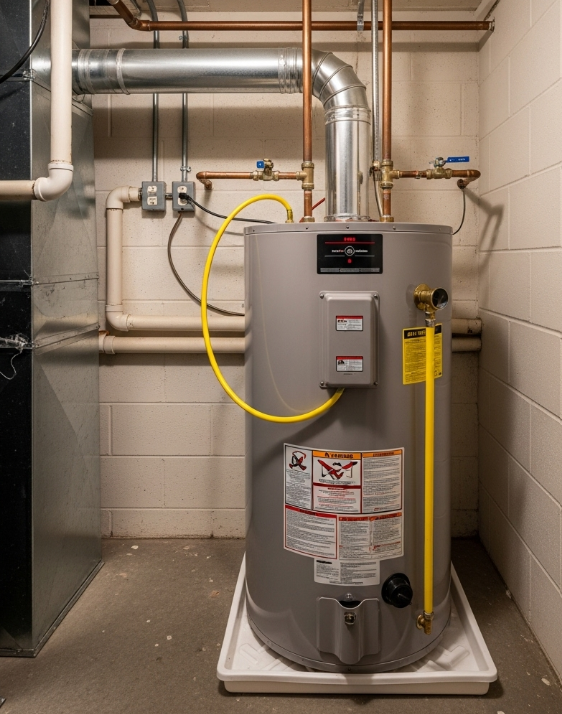
A conventional tank stores a fixed volume of hot water.
Pros
- usually the simplest like-for-like replacement;
- lower upfront cost than many major conversions;
- familiar technology;
- straightforward service.
Cons
- takes floor space;
- standby heat loss;
- finite stored hot-water capacity;
- a failed tank can release a significant amount of water.
Best fit: Homeowners who want a straightforward replacement without changing the home’s system dramatically.
Tankless water heater
Tankless units heat water as it is used rather than storing a full tank.
Pros
- compact;
- no large stored tank;
- can provide long-duration hot water when properly sized;
- may reduce standby losses.
Cons
- higher installation cost in many retrofits;
- gas models may require gas-line and venting changes;
- electric tankless systems can require substantial electrical capacity;
- sizing for simultaneous showers/appliances matters.
Best fit: Homes where space matters, long hot-water draws are common and the existing gas/electrical infrastructure supports the system without an unreasonable conversion cost.
Heat-pump water heater
A heat-pump water heater uses electricity to move heat from surrounding air into the tank rather than relying only on electric resistance heating.
Pros
- significantly more efficient than a conventional electric-resistance tank;
- may qualify for incentives;
- a strong option when replacing an electric tank.
Cons
- needs adequate air volume/installation conditions;
- makes some fan/compressor noise;
- cools and dehumidifies the surrounding space;
- installation details matter in Bend garages, utility rooms and cold spaces.
Best fit: Many electric-water-heater replacements where the location can accommodate the unit.
A very useful 2026 incentive to check
As of the latest 2026 Energy Trust of Oregon program update, qualifying heat-pump water heaters may receive substantial instant incentives. Energy Trust announced up to $1,200 for qualifying professional installations and a $1,000 retail instant discount for qualifying DIY purchases through participating channels.
Programs, eligibility, utilities and equipment requirements change. Check the current Energy Trust of Oregon water-heating incentives before you buy the equipment, because purchasing the wrong model or through the wrong channel can affect eligibility.
Bend permit requirement: this is important
The City of Bend currently states that replacing or installing a water heater requires a plumbing permit.
The City also says:
- an expansion tank is required when replacing or adding a water heater;
- electrical work may require an electrical permit;
- gas piping or venting work may require a mechanical permit;
- a final inspection is required.
The City’s current water-heater permitting guide lists a base permit fee and processing information, but fees can change. Use the City page for the current amount rather than relying on an old quote in a blog post.
City of Bend water-heater permitting guide
When comparing contractor quotes, ask explicitly: “Does your price include the permit and inspection?”
Why an expansion tank comes up on Bend replacements
When water heats, it expands. In a closed plumbing system, that thermal expansion can increase pressure. An expansion tank gives that extra volume somewhere to go.
Because the City of Bend currently requires an expansion tank for a replacement/addition, it should be part of the quote discussion rather than a surprise line item after the job begins.
Gas vs. electric: do not compare only the sticker price
A “cheap” heater can become expensive if the conversion requires major infrastructure changes.
If you already have gas
Ask whether the existing gas line and venting are adequate for the new unit - particularly for a high-input tankless system.
If you already have electric
Ask whether the circuit/panel capacity is adequate. A heat-pump water heater can often be a more natural efficiency upgrade from an existing electric tank than converting the whole system to gas or electric tankless.
How to size a water heater
Do not size only by the number of bedrooms.
Tell the plumber:
- number of people in the household;
- number of showers that may run close together;
- whether you have a large soaking tub;
- dishwasher/laundry patterns;
- whether guests frequently stay;
- whether the current tank ever runs out;
- for tankless, the simultaneous fixtures you expect to use.
For a storage heater, capacity and first-hour rating matter. For tankless, required flow rate and temperature rise matter.
Hot-water recirculation
Some Bend homes have recirculation systems that reduce the wait for hot water at distant fixtures.
If your current home has one, tell the installer before choosing a replacement. Ask:
- whether the new heater is compatible with the existing loop;
- whether the pump needs replacement;
- how the pump is controlled;
- whether a timer, demand control or smarter control strategy would reduce unnecessary energy use.
Questions to ask every installer
Use the same questions with two or three companies so the quotes are actually comparable:
- Are you recommending repair or replacement, and why?
- What exact model are you quoting?
- What is the tank size / first-hour rating / tankless flow specification?
- What is the equipment warranty?
- What labor warranty do you provide?
- Does the quote include removal and disposal of the old unit?
- Does it include the City of Bend permit and inspection?
- Does it include the required expansion tank?
- Are electrical, gas-line or venting upgrades included?
- Are there any likely add-on costs once work starts?
- Does this model qualify for current utility incentives?
- Who handles incentive paperwork or point-of-sale discounts?
- If tankless: what maintenance/descaling schedule do you recommend?
- If heat pump: is this installation location appropriate for noise, temperature and air volume?
What not to automatically add to the job
A water-heater failure can turn into a long list of optional upgrades. Some may be useful; others may not be necessary.
Ask the contractor to separate:
- required code/permit work;
- work necessary for the selected heater;
- recommended preventive upgrades;
- purely optional improvements.
That makes it much easier to understand the real replacement cost.
Maintenance basics
The correct maintenance depends on the water-heater type and manufacturer.
Common items can include:
- checking for leaks/corrosion;
- servicing or replacing an anode rod on applicable tank models;
- flushing sediment when recommended;
- cleaning heat-pump air filters;
- descaling tankless heat exchangers when required;
- checking recirculation equipment;
- inspecting venting/combustion components on gas systems.
Follow the specific manufacturer’s manual rather than a generic annual-maintenance rule from the internet.
Bottom line
For a straightforward Bend replacement, get at least two comparable quotes when time allows. Ask for the exact model, permit, expansion tank, warranty and all required electrical/gas/venting work in writing.
If you are replacing an electric tank in 2026, make sure you price a heat-pump water heater before automatically buying another conventional electric unit - the current efficiency incentives can materially change the comparison.
For related home help, see our guides to plumbers in Bend and home remodeling.